
Creating and Implementing a Viennoiserie Range
Develop an attractive and consistent artisan viennoiserie range tailored to your concept, equipment and real-world production constraints
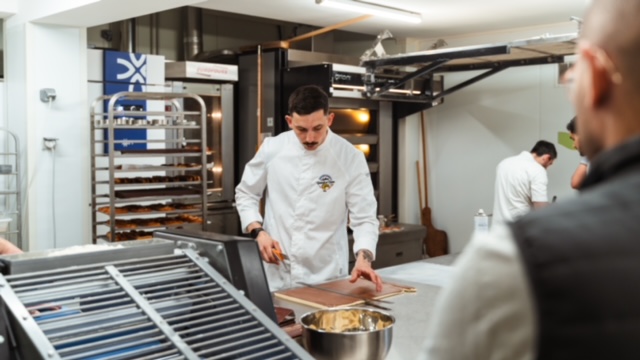
- Audience
- Bakers, pastry chefs, viennoiserie specialists, business owners, production teams, coffee shops, hotels, restaurants and entrepreneurs wishing to develop an artisan viennoiserie range.
- Prerequisites
- Basic knowledge of baking or pastry production and access to a suitably equipped production kitchen.
- Duration
- 3 days - 21h
- Format
- Intensive in-person training delivered in the client’s production kitchen. The range and products are agreed in advance according to the concept, the team’s experience, the available equipment and the establishment’s objectives.
- Price
- On quote
Learning objectives
- ◆Define a product range suited to the establishment’s positioning and customers. Master the production of the selected viennoiserie products. Adapt recipes, formats and finishes to production constraints. Organise the production of the entire range efficiently. Standardise recipes and methods to ensure consistent results. Reproduce the product range independently after the training.
Programme
Day 1 – Defining the range and starting production
- Analysis of the concept, customer profile and existing product offer
- Review of the production kitchen, equipment and workflow
- Identification of production, storage and sales constraints
- Definition of a consistent range suited to the establishment
- Selection of products, formats, fillings and finishes
- Presentation of the recipes and production methods
- Preparation of ingredients, doughs and fillings
- Completion of the first production stages
- Demonstration of mixing, lamination and shaping techniques
- Hands-on practice and correction of technical skills
Day 2 – Product development and production planning
- Continuation of the selected product range
- Production of the different shapes, fillings and finishes
- Adaptation of recipes to the available ingredients and equipment
- Definition of product weights, dimensions, thicknesses and formats
- Optimisation of cutting methods and reduction of dough waste
- Organisation of the different production stages
- Management of resting times, refrigeration and fermentation
- Production planning according to the establishment’s requirements
- Analysis of the initial results and implementation of adjustments
- Progressive standardisation of recipes and production methods
Day 3 – Finalisation, standardisation and independent production
- Production of the complete range under real working conditions
- Hands-on production with progressively greater participant autonomy
- Control of proofing, baking and finishing
- Evaluation of product quality, consistency and presentation
- Identification of defects and implementation of corrective actions
- Final adjustment of recipes, weights, formats and methods
- Organisation of the production schedule for the range
- Guidance on storage, conservation and preparation for sale
- Validation of recipe sheets and technical reference points
- Final review and recommendations for daily production
Funding & quality
- Teaching methods :
- Needs analysis, technical demonstrations, hands-on production by participants, practical exercises under real production conditions, individual corrections, recipe sheets and workflow guidance.
- Assessment :
- Initial assessment of needs and experience, continuous observation during production, evaluation of finished products, independent practical work and a final review of the skills acquired.
Training delivered directly to businesses.
(opens in a new tab)